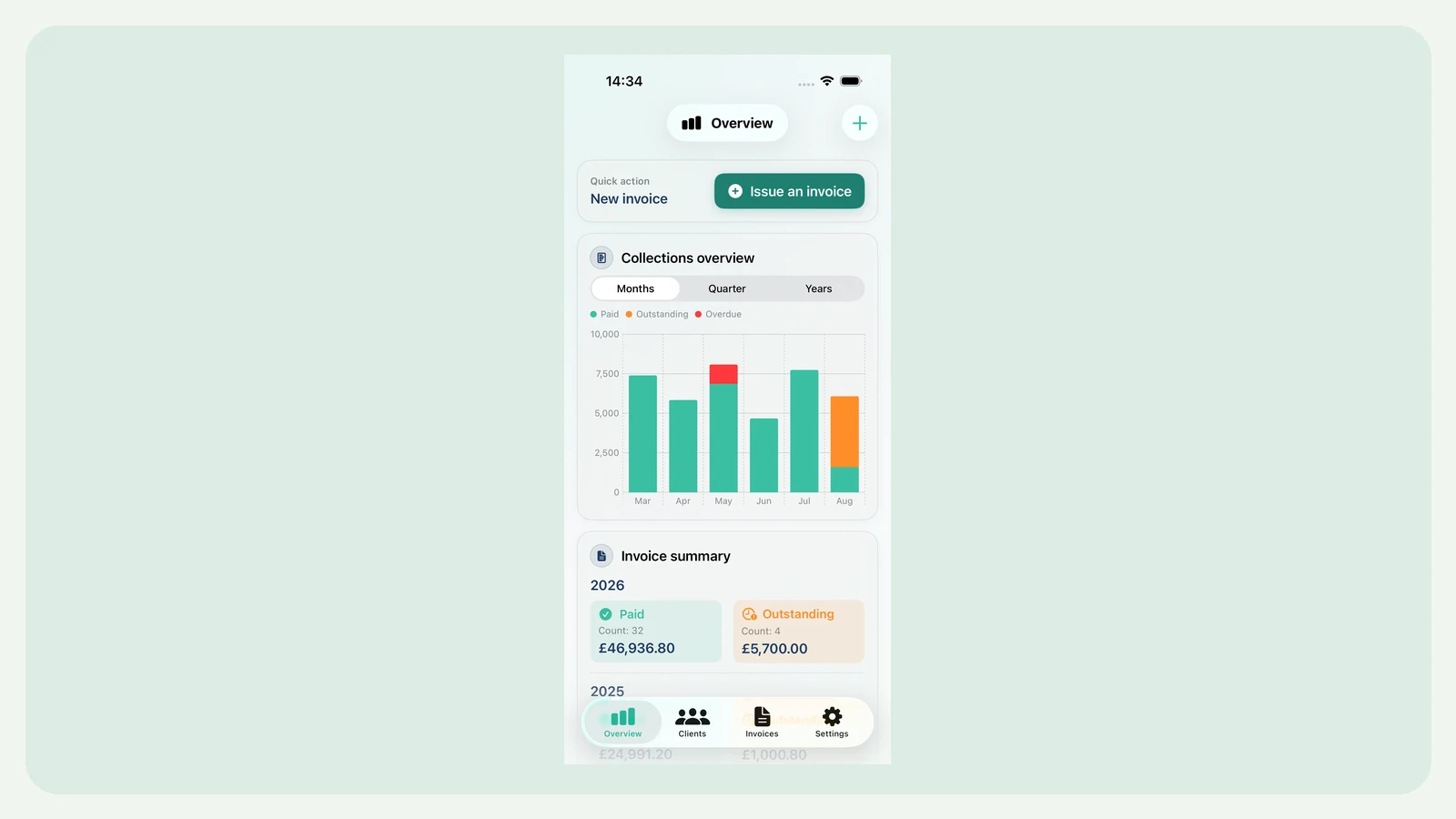
An issued invoice is not money in your bank account. If you work independently and have a manageable number of invoices, a regular check on your iPhone can keep outstanding payments visible. The aim is not to chase every customer each week. It is to establish what happened and leave every open invoice with a clear next action.
Start with the document, not the reminder
Fakturino distinguishes drafts, paid invoices, unpaid invoices and overdue invoices. These categories do not replace checking your bank account. Set unfinished drafts aside before reviewing issued invoices. Also check whether the customer actually received the invoice: creating a PDF is not proof that it was sent or delivered.
An unpaid invoice may not be due yet. Compare its due date with the current date and the agreed payment terms. If a customer promises to pay later, keep that promise in your own follow-up notes. A promised payment is not a received payment, and changing the original due date simply to clear an overdue indicator can obscure what happened.

Run the same five checks each week
- Review issued invoices that remain unpaid. Identify each by customer, invoice number, amount, currency and due date rather than by a familiar-looking title.
- Check incoming payments since your previous review in your banking app or statement. Compare the payer, payment reference and booked date as well as the amount.
- Only after verifying full payment, mark the corresponding invoice as paid manually. This workflow does not connect to your bank or match transactions automatically.
- Keep unresolved differences in your own working notes, with the invoice number and the next check needed.
- Separate the remaining invoices into not yet due, overdue and awaiting clarification. Give each unresolved issue a next action and a review date.
When the amount matches but the invoice does not
Consider a fictional case: two customers owe the same amount, and one payment arrives without a useful reference. Do not mark the first matching invoice as paid. Check the payer and any transaction message, then ask for clarification if necessary. The amount is one clue, not sufficient evidence of which invoice was settled.
For a partial payment, do not close the entire invoice as paid. Track the amount received and the remaining balance in your supporting records and agree the appropriate treatment with your bookkeeper. Apply the same caution to one transfer covering several invoices, a different currency or a deducted fee. A simple payment status cannot explain these differences for you.
Follow up only after checking the bank
For an invoice that is genuinely unpaid and past due, write your own short message: “Hello, could you please check payment of invoice [number], due on [date]? If payment has already been sent, please let me know the payment reference. Thank you.” Replace the placeholders and check the recipient and any attachment before sending.
This is a manual message template, not an automatic Fakturino reminder. An overdue status does not send an email, and preparing a message does not confirm delivery. A customer's reply helps you investigate; it does not by itself justify marking an invoice as paid.
Finish with a next action, not a guess
A weekly review is a suggested habit, not a guarantee of payment. Review more often if your transaction volume or cash needs require it. This general workflow is relevant to small UK service businesses too, but it is not advice on UK debt recovery, tax or statutory recordkeeping. It does not replace any required structured e-invoicing or reporting process.
Explore Fakturino’s features, then check current compatibility and availability on the linked App Store listing before trying sample data. If you also review invoices on a Mac, read about syncing invoices between your own Apple devices. Data sync is not payment verification.